Online Help for Probationary Captains
Limited Seating
Lead Before Others Decide They Cannot Follow You
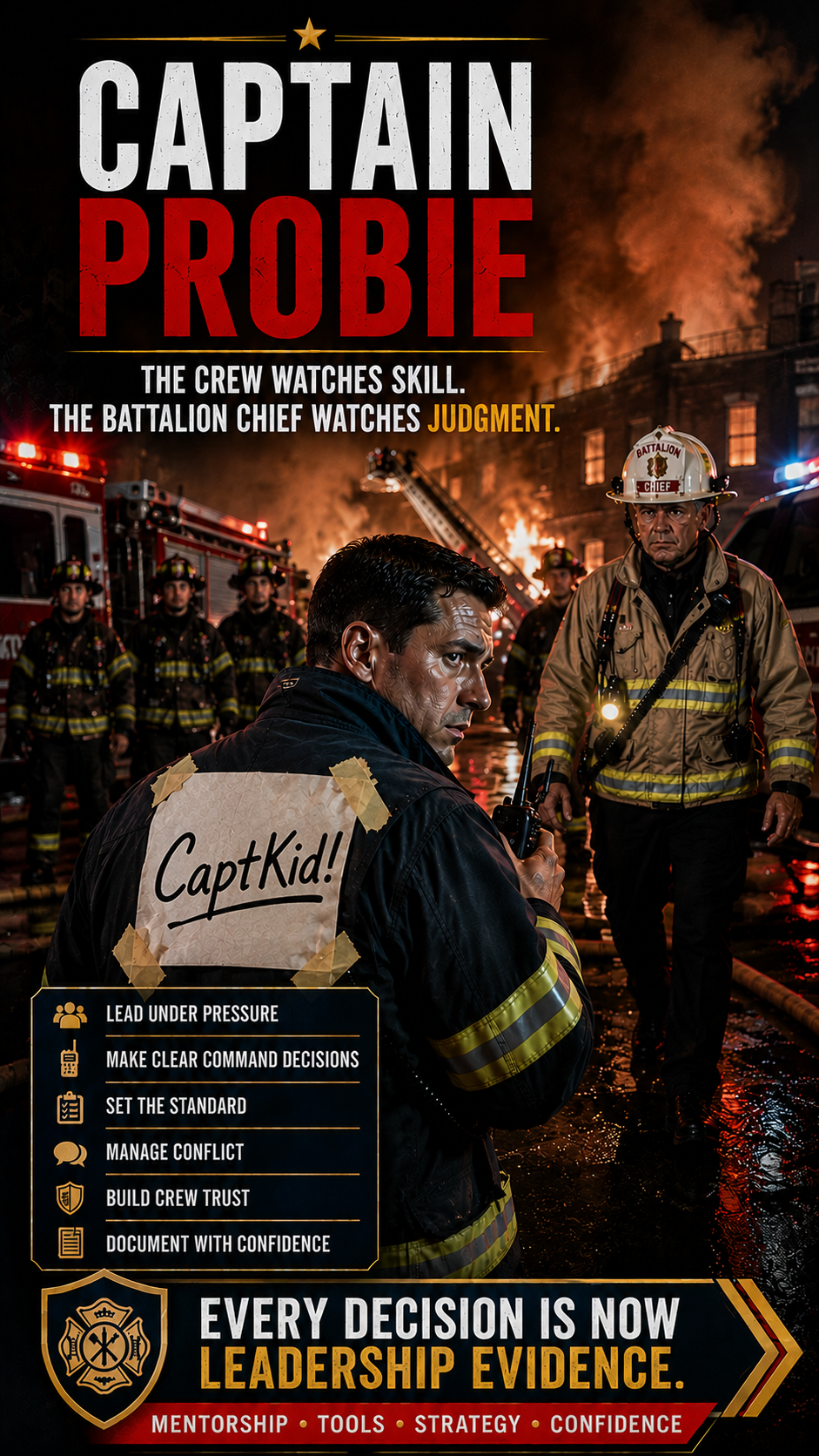
Promotion changed how every decision, correction, conflict, report, and emergency scene will now be judged.
Captain Probation Is Not Just A New Badge
Becoming captain does not automatically make people follow you. It puts your judgment on display.
Every shift now creates evidence. How you correct a firefighter, handle a complaint, document an incident, manage station expectations, talk on the radio, respond after a bad call, and prepare for evaluation all become part of your leadership reputation.
Probie Captain Size-Up was built for the newly promoted captain who wants more than a checklist. This program helps you understand why captain-level tasks exist, what can go wrong when they are handled poorly, and how to build confidence before a small mistake becomes a career problem.
Built From California-Grade Company Officer Expectations
Built from California-grade company officer expectations, Probie Captain’s Edge combines strong firefighter labor protections, OSFM company officer standards, and real probationary Fire Captain task book requirements from an operating fire department, then translates them into practical weekly scenarios for newly promoted captains in any agency.
The source task-book framework remains anonymous. The purpose is not to copy another department. The purpose is to use a demanding company officer development model to help you think more clearly inside your own AHJ, policy manual, MOU, civil service system, union environment, and chain of command.
Nobody Warns You About Captain Probation
The Battalion Chief Is Watching
You are now evaluated differently. Your decision-making patterns matter more than your technical skill. A skeptical evaluator does not need to invent failure. They only need you to be disorganized, emotional, undocumented, or casual with policy.
The Crew Is Quietly Judging You
Firefighters quickly determine whether your leadership creates confidence or confusion. The station studies how you handle pressure long before anyone says it out loud.
Small Conflict Becomes Big Conflict
Personnel issues ignored early often become command problems later. The goal is not to become harsh. The goal is to become fair, clear, and consistent before resentment hardens.
You Set The Station Tone
Training culture, kitchen expectations, accountability, discipline, wellness, documentation, and professionalism now reflect your leadership.
Documentation Matters
Reports, evaluations, task-book progress, crew conversations, public complaints, and follow-through become leadership evidence. If it is not documented correctly, it may become a memory contest later.
You Can No Longer Hide Weakness
As a firefighter, others could sometimes cover a mistake. As captain, your uncertainty, tone, hesitation, and shortcuts become visible immediately.
What Probie Captain’s Edge Gives You
This is not a pile of leadership slogans. It is a year-long mentoring path for the captain who wants to understand the job beneath the initials.
- 52 weekly Command Briefings released across the probationary year
- 12-month captain development calendar
- Scenario-based lessons tied to real probationary captain responsibilities
- Critical Evaluator Lens for every major topic
- Why this task exists and what can go wrong if handled poorly
- Live mentoring sessions with Captain Dave
- Confidential, anonymized discussion of leadership problems and incident questions
- Task-book confidence tracking
- Crew leadership and station culture guidance
- Personnel management and conflict walkthroughs
- Incident command decision exercises
- Documentation, reporting, and evaluation preparation
- Mental readiness and behavioral-health leadership woven throughout the year
- Local AHJ translation so the material fits your department, not someone else’s
Weekly Command Briefings
Each week, members receive a focused Command Briefing. These are not newsletters. They are practical leadership briefings designed to help you think like a company officer before the task, incident, or personnel issue lands in your lap.
Each Command Briefing is built around a captain-level responsibility and includes the reason behind the task, the risk it controls, how a skeptical evaluator may judge poor performance, and how to complete the work in a way that protects your crew, your agency, the public, and your future.
Every Command Briefing Includes
- Opening Size-Up
- Task Book Target
- Why This Task Exists
- Critical Evaluator Lens
- What Can Go Wrong
- Case Study
- Decision Point
- Legal, Policy, and Liability Anchor
- Mental Readiness Brief
- Behavioral Pivot
- Captain’s Drill
- Don’t Pencil-Whip This Warning
- Local AHJ Translation
- Captain’s Closing Line
Live Captain Mentoring Sessions
The live sessions are not locked to that week’s Command Briefing because every probationary captain is living a different version of the first year.
One captain may be dealing with a difficult evaluator. Another may be trying to earn crew trust. Another may be replaying a first-in decision, a personnel problem, a public complaint, a report-writing issue, or a task-book concern.
These sessions give you access to a human mentor who understands the fire service, understands probation, and will not shame you for asking the question you may be afraid to ask at the station.
How Live Sessions Work
- Bring questions from your probationary year
- Ask about crew issues, task-book pressure, documentation, incident decisions, or leadership concerns
- Submit questions ahead of time when you want more privacy
- Discuss anonymized scenarios without naming people, agencies, patients, or incidents
- If there are no questions, Captain Dave walks through a realistic captain-level incident, personnel issue, or current event
- Every session ends with practical takeaways you can bring back to your next shift
Live Session Confidentiality And Boundaries
Live sessions are designed to be respectful and confidential within the learning group. We remove identifying details before discussing incidents, personnel concerns, departments, patients, and coworkers. We will not share names, station numbers, incident dates, patient information, protected health information, or facts that could reasonably identify a person or agency.
This program provides mentoring, leadership education, and decision-making support. It does not replace department policy, legal counsel, union representation, EAP, peer support, medical advice, or chain-of-command direction.
Sample Weekly Command Briefing
Week 13: The Baseline Check After The Bad Call
Command Focus: Maintaining awareness of crew well-being after a high-stress incident.
Task Book Target: Crew performance observation, member assistance, safety readiness, and fitness-for-duty awareness.
Why This Task Exists: A captain is responsible for more than task completion. The captain must notice when a member’s behavior, attention, or readiness changes in a way that may affect crew safety.
Critical Evaluator Lens: A skeptical Battalion Chief may ask why you noticed a member was off but did nothing before the next response.
Case Study: After a high-acuity pediatric call, one of your younger firefighters becomes unusually quiet and does not complete post-incident equipment checks. The rest of the crew moves on quickly, and nobody says anything.
Decision Point: Do you force the member to talk immediately, give them space, quietly check in, notify someone, or use your agency’s peer-support or EAP pathway?
Legal, Policy, and Liability Anchor: Handle observable performance and safety concerns. Do not diagnose. Do not gossip. Do not create a public counseling session. Know your department’s peer support, EAP, fitness-for-duty, documentation, and chain-of-command expectations.
Mental Readiness Brief: The Baseline Check. Know what normal looks like for each member so you can recognize when normal changes.
Behavioral Pivot: The tough-guy persona is not corrected with shame. Redirect the conversation toward professional readiness, crew safety, and getting the right support early.
Captain’s Drill: Write a private check-in script that references observable behavior, not diagnosis. Example: “I noticed you were quiet after that call and the equipment checks were not finished like usual. I am not here to pry, but I do need to make sure you are okay to keep working and know what support is available.”
Don’t Pencil-Whip This Warning: Ignoring silent trauma may protect the station’s comfort, but it can endanger the next response.
Local AHJ Translation: Identify your agency’s peer-support, EAP, chaplain, behavioral health, fitness-for-duty, injury or exposure reporting, and supervisor notification process.
Captain’s Closing Line: You are not their therapist. You are responsible for noticing readiness.
This Program Is For The Captain Who Wants To Be Ready
- Newly promoted captains in their first year
- Acting captains preparing for permanent promotion
- Company officers who want stronger crew leadership habits
- Captains working through task-book expectations
- Captains with difficult evaluators or politically complicated probationary environments
- Captains who want a place to ask hard questions without being judged
This Is Not For You If
- You only want initials and do not care what the tasks mean
- You believe promotion automatically makes people follow you
- You are unwilling to check your own habits, ego, tone, and documentation
- You want someone to tell you to ignore your department’s policies
- You are looking for legal, medical, union, or therapy services instead of mentoring and leadership education
The Goal
The goal is not to help you perform like a captain for one evaluation meeting.
The goal is to help you become the kind of captain whose judgment, documentation, crew leadership, and incident decisions can survive scrutiny.
A weak captain asks, “What do I need to get signed off?”
A strong captain asks, “What risk is this task teaching me to control?”
Probie Captain’s Edge exists to build the second captain.
Join Probie Captain’s Edge
Get the weekly Command Briefings, live mentoring access, captain-level scenario guidance, and first-year-in-rank support designed to help you lead with confidence before others decide they cannot follow you.
Join Probie Captain’s Edge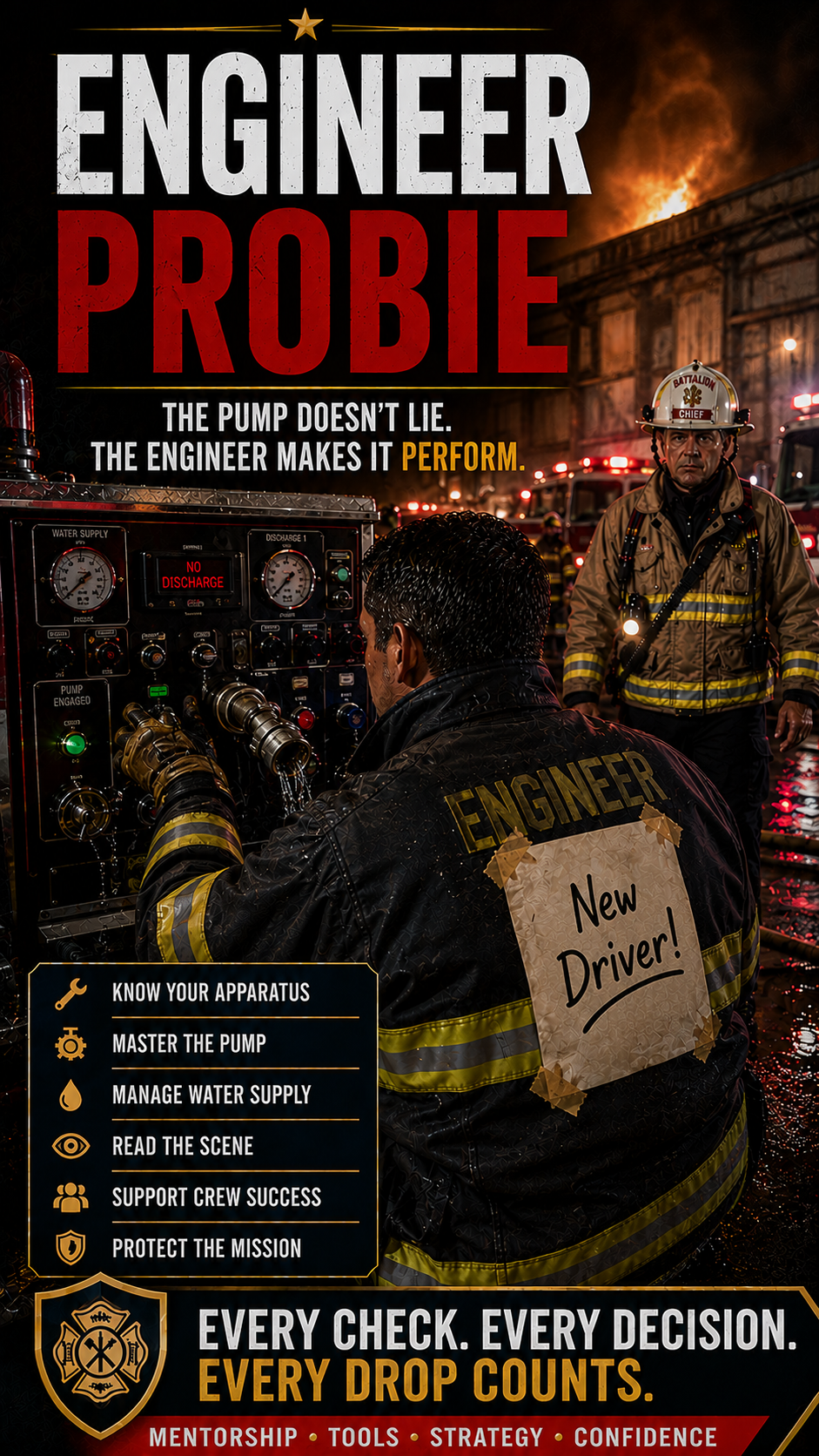
Engineer Probie Master The Seat Before The Seat Masters You
Promotion changed your responsibility overnight. The crew now depends on your driving, apparatus positioning, pump operation, water supply decisions, and tactical awareness.
What Quietly Ends Engineer Confidence
Apparatus Positioning
Did you leave room for Truck placement? Did you block access? Did you think ahead?
Pump Anxiety
Can you establish water supply quickly under pressure without hesitation?
Driving Pressure
Every intersection is now your responsibility. The captain trusts you until you prove otherwise.
Hydrant Discipline
Missing hydrants, poor lays, delayed water supply, and communication errors create immediate credibility problems.
Crew Dependence
A firefighter mistake affects one person. An engineer mistake can affect the entire operation.
Engineer Probie Membership Includes
- Weekly live engineer mentoring sessions
- Pump panel operation drills
- Friction loss cheat sheets
- Hydrant and water supply lessons
- Progressive hose lay training
- Intersection response awareness drills
- Apparatus positioning case studies
- Driver confidence building exercises
- Replay library
- Monthly engineer self-audits